
TL;DR
A strong branded event booth needs clear traffic flow, clean lighting, visible brand assets, fast sharing, and a follow-up plan. Physical booths work best for live engagement, while AI-first image workflows reduce setup friction when teams need polished branded visuals before, during, or after the event.
A photobooth photo booth setup for branded business events succeeds when the experience feels easy for guests and useful for the brand. The modern photo booth is digital, not just a coin-operated kiosk, and event teams now expect branded overlays, instant delivery, lead capture, and social-ready assets. For teams that want branded profile images or campaign visuals without a full onsite build, Looktara offers an AI-first creative path that can support event marketing before and after the booth goes live.
Table of Contents
What is a branded business event photo booth setup?
A branded business event photo booth setup is a planned photo experience that combines a camera station, lighting, backdrop, brand design, guest flow, image delivery, and post-event content use. A photo booth is commonly defined as an automated camera kiosk, and today most booths are digital rather than film-based.
Photo booth: A modern kiosk or station that captures guest photos, often with digital sharing, branded graphics, and event-specific design.
Branded booth: A photo booth adapted with company logos, colors, campaign messages, overlays, props, or sponsor placements.
Event output: The final photo, GIF, short video, print, QR gallery, email capture, or social media asset created from the booth.
SERP research for this topic found 176 results, and competitor pages often focus on rental ideas or starting a photo booth business. The gap is setup planning for brands that need the booth to serve marketing goals, not just entertain attendees.
Key insight: the best booth is not the biggest booth. The best booth is the one that guests can use quickly, understand instantly, and share without extra effort.
Branded event teams often pair booth content with broader campaign assets. For example, branded images from the event can support social posts, while a separate AI asset such as a fitness Instagram LinkedIn post generator can help turn campaign visuals into professional network content.
How should event teams plan the booth layout?
Event teams should plan the booth layout around visibility, queue control, lighting distance, guest comfort, and brand placement before choosing props or filters. A strong layout gives guests a clear entry point, a short wait, a private capture zone, and an obvious exit for sharing or printing.
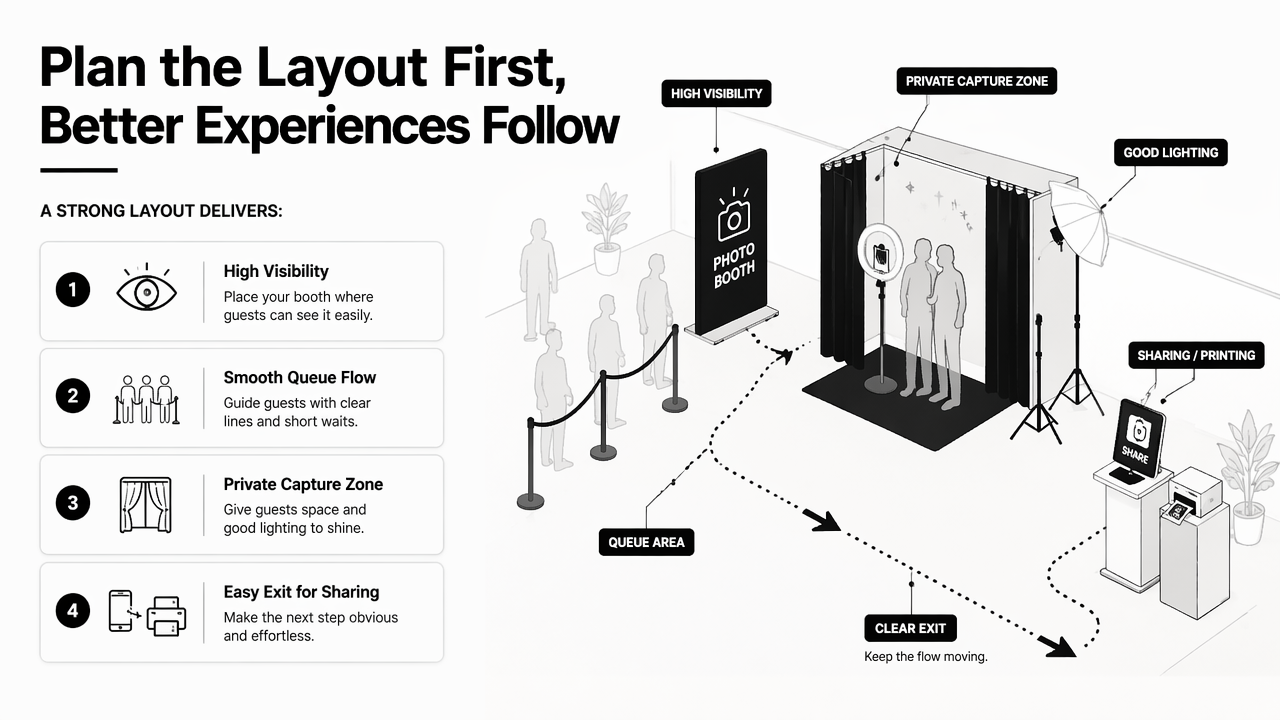
Most setup problems come from treating the booth as decor instead of traffic infrastructure. A booth placed too close to registration can block arrivals. A booth hidden near a service hallway may look clean on the floor plan but fail to attract guests.
Booth layout checklist for branded events
- Choose a high-visibility location: Place the booth near networking zones, lounges, sponsor areas, or exits rather than blocking registration.
- Leave room for the queue: Reserve standing space for guests, plus a separate exit path for finished users.
- Set camera distance: Open-air booths usually need enough space for full-body or group shots.
- Control the background: Avoid glass walls, cluttered corners, emergency signage, and uneven brand surfaces.
- Protect the light path: Keep uplights, stage beams, and sponsor screens from washing across faces.
- Mark sharing zones: Put QR codes, tablets, or print pickup away from the capture mark.
A clean physical setup includes the booth hardware, camera or tablet, power, lighting, backdrop, signage, staff table, and cable protection. For brand safety, logos should appear in places that look intentional: the backdrop, photo overlay, print template, landing page, or post-event gallery.
Physical setup versus AI-first workflow
| Setup choice | Best use case | Main strengths | Watch point |
|---|---|---|---|
| Open-air booth | Conferences, expos, product launches | Visible, social, easy for groups | Needs space and light control |
| Enclosed booth | Private parties, VIP activations | More privacy, nostalgic feel | Lower visibility and slower flow |
| 360 booth | High-energy launches, creator events | Motion content and spectacle | Needs staff supervision and floor space |
| Headshot station | Career fairs, sales kickoffs, founder events | Professional profile value | Requires tighter lighting and posing |
| AI-first branded images | Pre-event campaigns, remote teams, follow-up assets | Fast, flexible, no onsite footprint | Needs clear brand direction |
The Looktara platform fits the AI-first side of this table for teams that need polished branded images without building a full booth environment. It works especially well when event content must extend into profile photos, thumbnails, creator assets, or sponsor campaigns.
Which branding elements make booth photos shareable?
Shareable booth photos use branding that is visible, simple, and tied to the event message rather than overloaded with logos. Guests share images when they look good in them, so brand elements should frame the person, not compete with the person.
A common misconception is that stronger branding means larger logos. In practice, the best brand recall often comes from clean color systems, repeatable graphic patterns, short campaign lines, and a polished photo template. A crowded overlay can make a photo feel like an advertisement, which lowers the chance of voluntary sharing.
Brand assets that belong in the setup
- Backdrop: Use brand colors, patterns, product visuals, or event theme graphics.
- Overlay: Add a small logo, event name, date, or campaign line.
- Props: Keep props tied to the industry, product, or audience rather than random party items.
- Landing page: Match the photo gallery or download page to the same visual identity.
- Social templates: Prepare vertical crops for Instagram Stories, TikTok covers, YouTube Shorts, and LinkedIn posts.
- Sponsor placements: Separate sponsor marks from the guest's face and main image area.
Teams planning multi-channel promotion can extend booth images into platform-specific assets. A brand can turn event stills into social visuals with a fitness Instagram story AI generator, then use campaign crops for creator-friendly covers through a fitness Shopify TikTok cover AI generator.
Booth content formats by channel
| Channel | Best booth output | Design priority |
|---|---|---|
| Professional headshot, team photo | Clean background, subtle logo, sharp face lighting | |
| Instagram Stories | Vertical image, GIF, branded frame | Bold color, clear event tag, mobile-first crop |
| TikTok | Motion clip, 360 spin, before-and-after | Movement, expressive pose, fast brand recognition |
| Email follow-up | Download link, gallery, thank-you image | Clear CTA, event name, sponsor recognition |
| Internal comms | Team collage, leadership photo, recap image | Consistent style and easy reuse |
Good booth branding starts before the event. Brand managers should send the booth vendor exact logo files, fonts, colors, safe zones, file formats, and sample layouts early enough for testing.
How should staffing, delivery, and follow-up work?
Staffing, delivery, and follow-up should be planned as one workflow because the booth experience does not end when the photo is taken. A branded booth needs a greeter, a technical operator, a sharing path, consent language, and a clear plan for using the final assets.
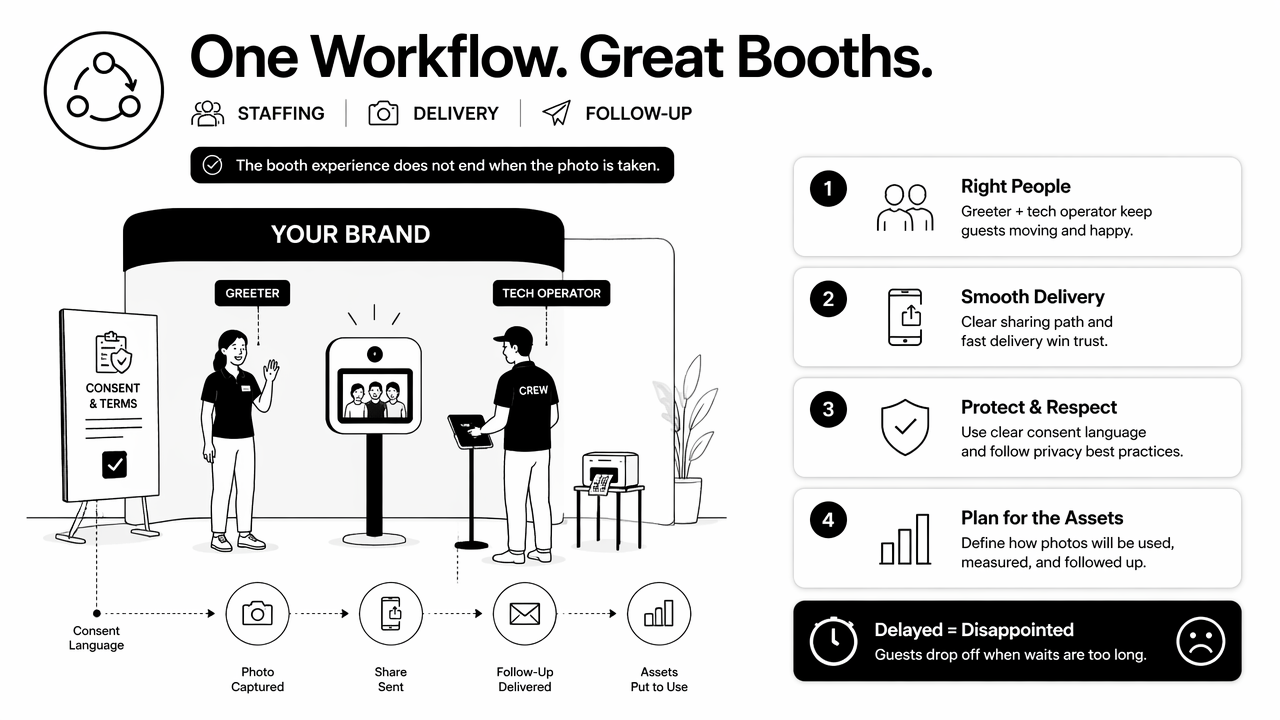
Event booths fail quietly when guests wait too long, cannot find their images, or do not understand how the photo will be used. The fix is a simple staffing model and a short delivery path.
Recommended onsite workflow
- Greeter explains the experience: A staff member points out the booth, expected wait, and output format.
- Guest enters capture area: Floor marks help keep faces in focus and groups centered.
- Operator checks framing: The operator confirms lighting, logo visibility, and retakes when needed.
- Guest approves or retakes: A quick preview protects quality and reduces complaints.
- Image is delivered: Delivery can happen by QR code, text, email, AirDrop, print, or gallery.
- Follow-up is triggered: The brand sends a thank-you note, download link, promotion, or event recap.
Consent deserves special care. If images may appear in ads, recap videos, social posts, or internal decks, event teams should make that clear at the capture station and in the delivery flow. Short signs, checkbox language, and staff scripts help avoid confusion.
Follow-up assets after the event
| Follow-up goal | Useful asset | Timing |
|---|---|---|
| Drive social sharing | Branded gallery link | Same day |
| Support sales outreach | Prospect photo plus event context | 1 to 2 business days |
| Thank sponsors | Sponsor-branded recap collage | Within the week |
| Build employer brand | Team photo set | Within the week |
| Promote next event | Best-of content package | 1 to 3 weeks |
Post-event content often needs new crops and thumbnails. Teams repackaging booth images for video or ecommerce content can use a fitness Shopify YouTube thumbnail AI generator or create product-style visuals with a fitness Instagram product photo AI generator.
What will change for event booths in 2027?
Event booths in 2027 will likely blend physical capture, AI styling, profile-ready outputs, and campaign analytics more tightly than traditional print-first booths. The booth will still be a social moment, but the business value will come from reusable branded assets and faster distribution.
The top ranking competitor content includes a 2026 guide focused on the photo booth business and a 2026 corporate event ideas article. That focus reflects where the category is heading: event photography is no longer just a novelty rental. It is becoming a content production channel.
Practical changes to expect
- More profile-ready outputs: Career fairs, sales events, founder meetups, and remote team gatherings will ask for LinkedIn-style headshots.
- More AI retouching and styling: Guests will expect polished results without a long editing delay.
- More sponsor reporting: Brands will want proof that booth content was created, shared, downloaded, or reused.
- More remote extensions: Teams that cannot attend in person will still need matching branded visuals.
- More vertical-first design: Event assets will be planned for Stories, Shorts, TikTok, and LinkedIn before print.
A smart 2026 setup already prepares for that shift. The booth should capture clean source images, preserve permission data, and export content in sizes that fit each channel.
Looktara can support this direction by helping teams create consistent, polished profile and campaign imagery around the event, especially when onsite space, travel, or vendor coordination is limited. More details are available at looktara.com for teams comparing physical and AI-first visual workflows.
Frequently asked questions
How much space does a branded event booth need? A branded event booth needs enough room for the capture area, queue, equipment, lighting, and sharing station. Open-air setups usually need more visible floor space than enclosed booths because group photos and branded backdrops require distance. Event teams should confirm exact dimensions with the booth provider before final floor plans are approved.
Is an iPad booth good enough for a corporate event? An iPad booth can work well for casual branded activations, small events, and fast social sharing. A camera-based booth or headshot station is usually better when the brand needs sharper portraits, controlled lighting, or executive-level polish. The right choice depends on output quality, guest volume, and the event's marketing goal.
Should booth photos include logos? Booth photos should include logos when the branding is subtle, readable, and placed away from faces. Oversized logos can make guests less likely to share the photo. A better approach uses a clean backdrop, small overlay, event hashtag, and brand colors that make the photo feel personal and campaign-ready.
Can AI replace a physical event booth? AI can replace some booth needs, especially pre-event headshots, remote team visuals, and post-event campaign images. Physical booths still create live energy, networking moments, and sponsor visibility. Many business events will get the best result from using both: onsite capture for engagement and AI-first tools for polished content reuse.
Conclusion
A strong photobooth photo booth setup for branded business events starts with the business goal, then works backward into layout, lighting, branding, staffing, delivery, and follow-up. Event teams should choose a physical booth when live interaction matters most, and add AI-first visuals when polished content needs to scale beyond the venue. For campaign-ready images, profile assets, and branded creative support around an event, visit looktara.com and compare that workflow with the planned onsite booth before finalizing the production budget.
Generated by EarlySEO.com