
TL;DR
AI dating photos work best when they improve lighting, variety, and context without changing identity, age, body type, or lifestyle. A strong profile should mix realistic AI-assisted images with at least one recent candid photo, then match the photo style to the dating app goal.
A realistic artificial intelligence photo generator for dating profile photos can fix a common profile problem: most people have too few clear, recent, well-lit photos that show personality. Looktara helps create polished profile imagery for people who need a dating-ready look as well as professional photos for work, including AI resume headshots for profile updates. The real question in 2026 is not whether AI can make attractive photos; it is whether those photos still feel honest enough to earn trust after the match.
Table of Contents
What is an AI dating photo generator?
An AI dating photo generator is software that uses artificial intelligence to create or improve dating profile pictures from selfies, prompts, or uploaded images while preserving a recognizable human identity. The best tools improve lighting, backgrounds, clothing variety, and composition without making the subject look like a different person.
Artificial intelligence: computational systems that perform tasks associated with human intelligence, such as perception, reasoning, learning, and image generation.
AI dating photo: a profile image generated or enhanced by AI for use on apps such as Tinder, Bumble, Hinge, or niche dating communities.
Research on deep neural networks, including the review by Samek, Montavon, and Lapuschkin in Proceedings of the IEEE, explains why modern AI systems can produce convincing outputs while still needing careful evaluation and explainability (source). For dating profiles, that means good-looking images still need a human realism check.
Key insight: AI-generated dating photos should act like a better camera day, not a fictional identity.
Current search results show a crowded category, with tools promising AI photos for Tinder, Bumble, and Hinge, sometimes from only a small selfie set. That convenience is useful, but it also raises the trust standard. A photo that looks too perfect can create suspicion before a conversation starts.
When does AI improve dating profile photos?
AI improves dating profile photos when it fixes presentation problems while keeping appearance, age, expression, and lifestyle accurate. It is most useful for people with outdated selfies, poor lighting, cluttered backgrounds, or too many photos taken from the same angle.
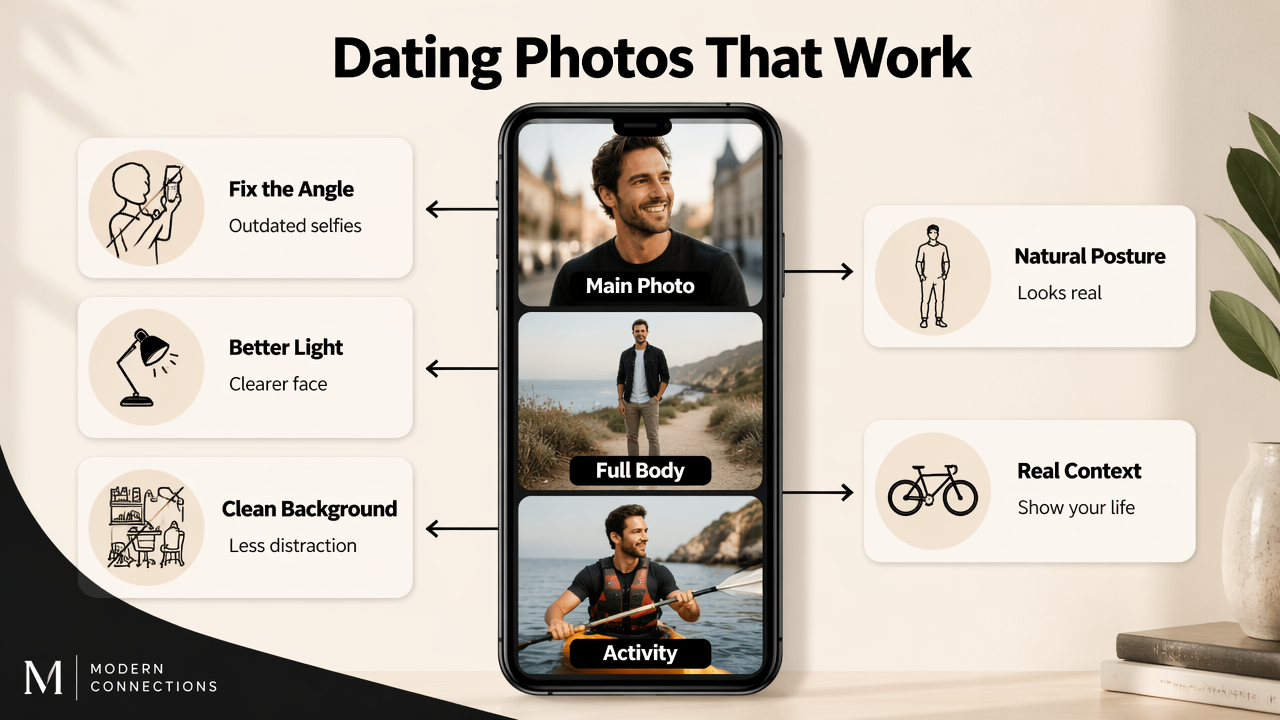
Best uses for realistic AI-assisted profile images
AI is strongest when it adds variety that a normal photo session would capture. A dating profile benefits from range, not fantasy.
- Use one clear head-and-shoulders image as the main photo.
- Add one relaxed full-body photo with natural posture.
- Include one activity photo tied to a real hobby.
- Add one social or lifestyle image that does not confuse identity.
- Keep one recent non-AI candid photo for authenticity.
Remote workers, founders, and creators often need one visual identity across dating apps and professional platforms. A person building both dating and career presence can pair dating images with LinkedIn post visuals for a polished professional feed, as long as dating images stay warmer and less corporate.
Where AI should not replace real photos
AI should not replace every dating profile image because dating apps depend on trust, recognition, and a sense of real life. Fully synthetic galleries can feel like AI slop, a term used for high-volume generative content perceived as low-effort, low-quality, or made mainly to gain attention.
Avoid AI outputs that change:
- Face shape, skin texture, or age in a noticeable way
- Body size, height cues, or hairline
- Lifestyle signals, such as luxury travel or extreme fitness, that are not accurate
- Social context, especially fake groups or fake pets
- Cultural, religious, or professional markers with personal meaning
A good rule is simple: the first in-person meeting should confirm the photo, not explain it.
How should dating app photos differ by goal?
Dating app photos should differ by goal because Tinder, Bumble, Hinge, and niche apps reward different signals, from instant visual clarity to conversation depth. A strong AI photo set should be built around the app's behavior, not copied across every profile.
Photo strategy by app type
| App or profile goal | Best photo style | AI can help with | Avoid |
|---|---|---|---|
| Tinder or swipe-heavy apps | Clear, high-energy first image | Lighting, outfit variety, stronger backgrounds | Overly edited glamour shots |
| Bumble | Friendly, confident, approachable photos | Natural smiles, clean framing, casual polish | Corporate headshot-only profiles |
| Hinge | Personality-rich images with prompts | Hobby scenes, travel-style context, better composition | Fake activities or staged-looking scenes |
| Niche dating apps | Values and lifestyle clarity | Consistent visual tone, modest edits, context | Generic model-like images |
| Creator or public profile dating | Authentic but brand-aware images | Consistent color, sharp thumbnails, recognizable style | Influencer-style perfection in every photo |
People who already create social content can keep visual consistency across platforms. For example, dating profile images may share a clean aesthetic with TikTok cover images for personal brand campaigns, but the dating version should look more candid and less promotional.
The Looktara platform fits this trust-first approach because profile imagery can be treated as part of a broader personal brand system rather than a one-off vanity edit.
What makes AI dating photos look authentic?
AI dating photos look authentic when they keep normal human variation, real-world imperfections, and believable context. The goal is not maximum attractiveness; the goal is a profile that feels attractive, current, and safe to meet.
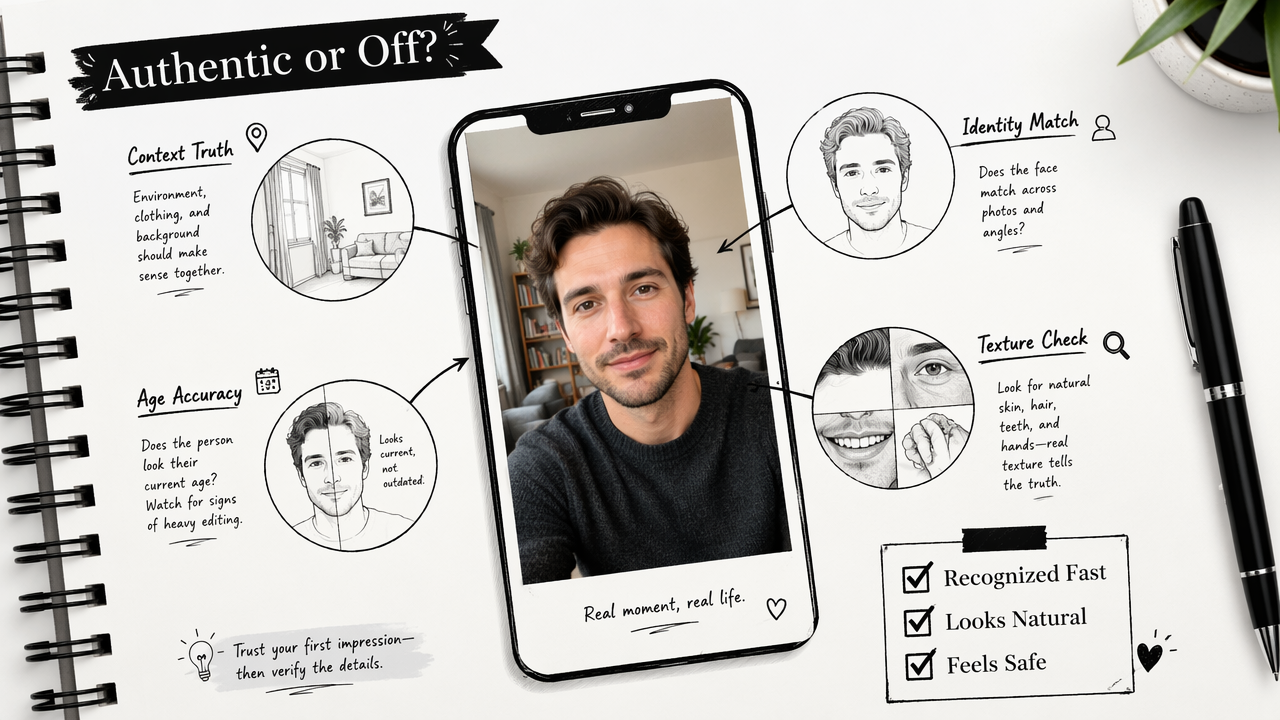
Realism checklist before publishing
A dating profile photo should pass a fast realism audit before it goes live.
- Identity match: the person would be recognized immediately in real life.
- Texture check: skin, hair, teeth, and hands look natural.
- Age accuracy: the image reflects current age, not an idealized past version.
- Context truth: clothing, location, hobbies, and social cues are believable.
- Gallery balance: not every image has studio-perfect lighting.
- Prompt consistency: captions and photos tell the same story.
AI art systems often generate visually appealing images, but dating apps carry a higher social cost than creative art. Park and Kim's IEEE Access paper on metaverse applications and open challenges discusses identity and virtual environments as part of a broader digital interaction shift (source). Dating profiles sit inside that same shift, where digital presentation affects real-world trust.
A strong profile mix for 2026
A balanced dating profile should combine AI-assisted polish with real-life proof. One useful mix is:
- Main photo: realistic AI-enhanced headshot with eye contact.
- Full-body photo: natural pose, accurate proportions, simple background.
- Activity photo: real hobby, sport, event, cooking, hiking, music, or art.
- Social proof photo: one image with others, cropped or selected so identity stays clear.
- Candid photo: recent phone photo with imperfect but warm energy.
- Conversation starter: a photo that supports a prompt or bio detail.
Short-form creators can also adapt a similar hierarchy for thumbnails and profile branding. A person building dating and creator presence may use AI shorts thumbnail designs for recognizable visual identity, while keeping dating photos less staged.
What should change in 2027?
AI dating photos in 2027 will likely move toward stronger disclosure norms, better realism scoring, and more app-level checks for misleading edits. Dating apps have an incentive to reduce catfishing, while users still want better photos without booking a full shoot.
Trust signals will matter more than polish
The next wave of dating profile tools will probably focus on proof, not perfection. Expected changes include:
- More labels for AI-generated or AI-edited images
- Stronger detection of face swaps and identity changes
- Profile prompts that verify lifestyle claims
- Demand for recent candid images alongside polished shots
- Better tools for matching photos to app-specific goals
For entrepreneurs, creators, and freelancers, the same trust problem applies beyond dating. A website hero image, social profile, and dating photo can all look polished, but each must fit its context. Brand-facing visuals can be more designed, such as AI website hero images for fitness and commerce pages, while dating photos should stay more personal.
How Looktara fits a trust-first workflow
Looktara is best used as part of a simple profile workflow: create realistic options, remove anything that changes identity, select photos by app goal, then keep at least one recent candid image in the final set. That process gives AI a helpful role without letting it take over the whole profile.
A practical publishing rule works well: if a match would feel surprised, disappointed, or misled after meeting, the image is too edited. If the photo simply shows a clear, confident version of the same person, it belongs in the shortlist.
FAQ about AI dating profile photos
Are AI-generated dating photos allowed on dating apps?
AI-generated dating photos may be allowed depending on the app's current rules, but misleading identity edits can violate trust and safety expectations. The safest approach is to use AI for lighting, styling, and background improvements while keeping identity accurate and including at least one recent real candid photo.
Do AI dating photos count as catfishing?
AI dating photos count as catfishing when they create a false impression of age, body type, face, lifestyle, or social status. They do not have to be deceptive when they function like professional photography: better lighting, cleaner framing, and realistic outfit variety for the same recognizable person.
How many AI photos should a dating profile use?
A strong profile can use two to four AI-assisted photos if the full gallery still includes recent real-life images. The better mix is not all AI or no AI; it is a set that feels varied, current, and believable across headshot, full-body, activity, and candid moments.
What is the biggest mistake with AI dating photos?
The biggest mistake is choosing the most flattering image instead of the most believable one. Hyper-smooth skin, fake travel scenes, luxury cues, altered bodies, or model-like poses may earn attention, but they can reduce trust once a conversation or meeting happens.
Conclusion
An artificial intelligence photo generator for dating profile photos is worth using when it improves clarity, confidence, and variety without changing the truth of the person shown. The best next step is to build a six-photo set, run each image through the realism checklist, and remove anything that would need an explanation in person.
For a trust-first profile refresh, create polished options with Looktara, keep the most natural results, and pair them with recent candid photos. For broader personal branding, related assets such as a Pinterest pin generator for fitness and lifestyle visuals can support a consistent online presence. To start, visit looktara.com and choose images that look like a better photo day, not a different life.
Generated by EarlySEO.com